See which of the 12 patterns behind failed modernizations your program is showing — 8 minutes, no email. Take the diagnostic →

Navigating Architecture-Driven Transformation
Stratonavis guides CTOs and engineering leaders through strategic modernization, blending cloud-native design with AI to future-proof enterprise systems effectively.
5/8/20243 min read
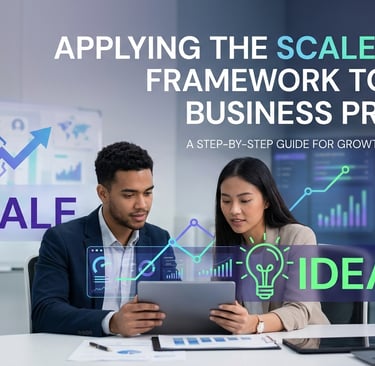
From Chaos to Growth: How to Apply the SCALE and IDEAS Frameworks to Your Business Project
If you are running a business project, you have likely hit that familiar wall: you have a great vision, but the day-to-day operations are dragging you down. You are juggling too many tasks, struggling to innovate, and wondering why your growth has stalled.
The secret to breaking through isn't just working harder—it’s working with a framework.
In this guide, we’ll explore how to apply the IDEAS framework to spark innovation and the SCALE framework to turn that innovation into sustainable growth.
Part 1: The IDEAS Framework (For Strategy and Innovation)
Before you can grow, you need to know what to build. The IDEAS framework is your map for project strategy and problem-solving.
1. Identify
Start by identifying the friction point. What is the biggest challenge your project is currently facing? Is it low conversion rates on your landing page? Poor customer retention?
Action: Write down the "Big Pain" your project is trying to solve.
2. Define
Vagueness is the enemy of progress. Define the problem clearly so the whole team understands it. Instead of saying "Our marketing isn't working," define it as "Our email open rate has dropped by 15% in the last quarter."
Action: Create a single, clear problem statement.
3. Explore
This is the brainstorming phase. Look for inspiration. How are competitors solving this? What do your customers say in their feedback?
Action: Research three different potential solutions to your defined problem.
4. Assess
Be realistic. You might have ten great ideas, but you only have the budget and time for one. Assess your options based on difficulty vs. impact.
Action: Use a matrix to rank your ideas. Choose the one with the highest potential impact and lowest initial barrier to entry.
5. Select
Pick your winner. Commit to it. A project that tries to change everything at once changes nothing at all.
Action: Document your selected path and set a launch date.
Part 2: The SCALE Framework (For Operational Growth)
Once you’ve used IDEAS to pick your path, use the SCALE framework to ensure your project doesn't collapse under its own weight.
1. Standardize
You cannot scale chaos. If every task is done differently every time, you will burn out. Create templates, checklists, and standard operating procedures (SOPs).
Application: Create a simple checklist for how you publish a blog post or handle a customer inquiry.
2. Systematize
Turn your standards into a system. This means connecting the dots so that one task leads naturally to the next.
Application: Use project management tools like Trello, Asana, or Notion to ensure everyone knows where their tasks fit in the bigger picture.
3. Automate
Technology is your greatest leverage. If you are doing something manually that a piece of software can do, you are losing money.
Application: Set up automated email sequences, use chatbots for initial customer support, or integrate your web forms with your CRM.
4. Leverage (Delegate)
You are the business owner; your time is the most expensive asset. Delegate tasks that don’t require your specific expertise to freelancers, assistants, or team members.
Application: Identify the three tasks you do every day that you hate doing, and assign them to someone else.
5. Elevate (Expand)
Once you have the systems in place, it’s time to amplify. Now that your project is running smoothly, look for ways to increase traffic, sales, or production.
Application: With your new systems, can you increase your ad budget? Can you enter a new market? Can you double your output?
Putting It Together: Your Roadmap
To move your project from an idea to a scalable success, follow this sequence:
Use IDEAS to clarify: Don't start scaling a bad idea. Spend 48 hours running your project through the IDEAS framework to ensure you are solving the right problem.
Use SCALE to execute: Once the strategy is locked in, shift your mindset to operations. Every week, ask: "Which letter of the SCALE framework am I currently building for this project?"
Final Thoughts
Running a project is a marathon, not a sprint. By using the IDEAS framework to stay strategic and the SCALE framework to stay efficient, you stop being a business owner who is "too busy to grow," and start being a leader who builds systems that grow for you.
Ready to scale? Start by reviewing your project today—what is one task you can automate before the end of the week?

Talk to an Expert
Discuss your modernization challenges and define the right architecture strategy for your platform.
Architecture-led decision making
Proven modernization outcomes
Enterprise-scale delivery experience
All rights reserved © 2026 Stratonavis Private Limited
Proven across global financial platforms and large-scale enterprise systems.
Trusted by global financial platforms and enterprise systems