See which of the 12 patterns behind failed modernizations your program is showing — 8 minutes, no email. Take the diagnostic →

Markdown: The Universal Language of Modern Engineering
Why Modern Engineering Teams Should Treat Markdown as a Strategic Asset
Rajesh Kumar P B
7/8/20263 min read
Why Modern Engineering Teams Should Treat Markdown as a Strategic Asset
Modern software engineering is no longer just about writing code. High-performing engineering organizations also excel at capturing, sharing, and evolving knowledge.
Whether designing cloud-native platforms, documenting architectural decisions, managing operational runbooks, or building AI-powered developer experiences, one technology quietly sits at the center of these workflows:
Markdown.
Often dismissed as a lightweight markup language for README files, Markdown has evolved into the de facto standard for engineering documentation, Docs-as-Code practices, developer portals, and AI-assisted software development.
For engineering leaders, this is more than a documentation choice—it is an architectural decision.
The Evolution of Technical Communication
Engineering has always required balancing two competing goals:
Information must be easy for people to read.
Information must be structured enough for machines to process.
Over time, different technologies addressed these needs:
TechnologyPrimary PurposeXMLStructured document representationJSONStructured data exchangeMarkdownStructured engineering knowledge
Each remains valuable.
However, Markdown occupies a unique position by combining readability, portability, and machine-friendly structure, making it ideal for modern engineering workflows.
Why Markdown Matters Today
Markdown has become the common language across today's engineering ecosystem.
It is widely used for:
Architecture Decision Records (ADRs)
Technical specifications
API documentation
Engineering standards
Incident reports
Operational runbooks
Product documentation
Developer portals
Knowledge bases
Technical books
Static websites
AI prompt libraries
A single Markdown document can be:
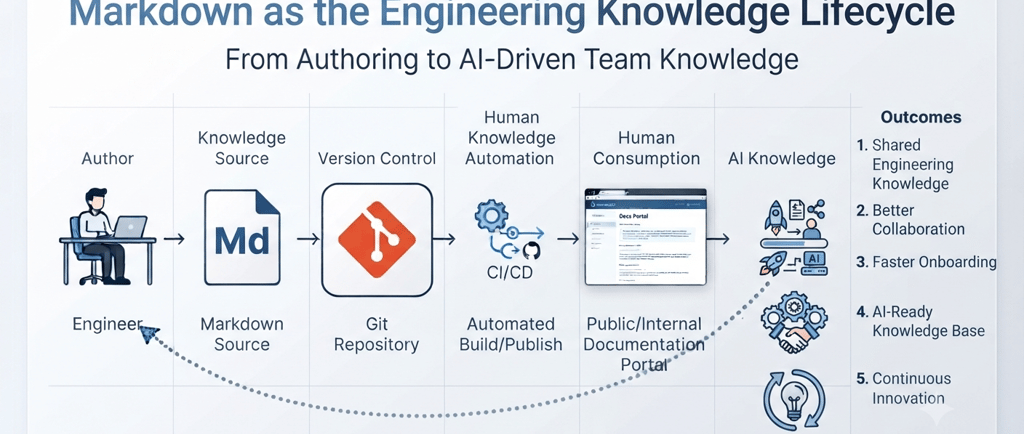
Version controlled with Git
Reviewed through Pull Requests
Published automatically using CI/CD
Converted into PDFs or websites
Indexed for enterprise search
Consumed directly by AI systems
This "write once, publish everywhere" capability significantly reduces duplication while improving consistency across engineering teams.
Docs-as-Code: Engineering Knowledge as a First-Class Asset
Forward-thinking organizations increasingly adopt the Docs-as-Code approach.
Rather than treating documentation as a separate activity, documentation evolves alongside software throughout its lifecycle.
Key characteristics include:
Version-controlled documentation
Peer-reviewed changes
Automated publishing
Continuous improvement
Traceability to architecture and implementation
The result is documentation that remains current, trustworthy, and aligned with the software it describes.
For regulated industries such as banking, healthcare, telecommunications, and government, this approach also improves governance and auditability.
Markdown and the Rise of AI-Assisted Engineering
Artificial Intelligence has fundamentally changed how engineering teams consume knowledge.
Large Language Models (LLMs) perform best when information is organized with clear semantic structure.
Markdown naturally provides:
Headings
Sections
Lists
Tables
Code blocks
Hyperlinks
This makes Markdown an excellent foundation for:
Retrieval-Augmented Generation (RAG)
Internal engineering copilots
AI-powered documentation assistants
Intelligent knowledge search
Automated developer support
Well-structured Markdown improves both human understanding and machine interpretation, enabling more effective collaboration between engineers and AI systems.
Why Chief Architects Should Care
Architecture is not only about designing systems.
It is equally about preserving architectural intent.
As technology evolves, programming languages, frameworks, cloud platforms, and deployment models will inevitably change.
The knowledge behind architectural decisions, however, must remain accessible.
Markdown offers a vendor-neutral, durable, and future-friendly way to preserve that knowledge.
Combined with Git and modern documentation platforms, it creates an engineering knowledge base that evolves continuously alongside the software.
Building Markdown Maturity
Organizations looking to strengthen their engineering documentation practices should move beyond basic Markdown syntax and adopt a broader ecosystem.
Recommended areas include:
CommonMark for standards compliance
GitHub Flavored Markdown (GFM)
Mermaid for architecture and sequence diagrams
Architecture Decision Records (ADRs)
MkDocs or Docusaurus for documentation portals
Pandoc for multi-format publishing
Docs-as-Code workflows integrated with CI/CD
AI-ready documentation practices
These capabilities help engineering organizations build documentation that is maintainable, searchable, and automation-friendly.
Final Thoughts
Programming languages enable us to communicate with computers.
Markdown enables us to communicate with engineers, stakeholders, and increasingly, intelligent systems.
As organizations embrace cloud-native architectures, platform engineering, and AI-assisted development, documentation can no longer be treated as an afterthought.
It must become part of the engineering system itself.
Markdown has quietly become the universal language for engineering knowledge—and organizations that master it will be better positioned to scale collaboration, improve governance, accelerate onboarding, and unlock the full value of AI-assisted software development.
About Stratonavis
At Stratonavis, we help enterprises modernize software engineering through architecture excellence, cloud-native transformation, AI-assisted development, engineering intelligence, and modern delivery practices. Our focus is not only on building better software but also on helping organizations build sustainable engineering capabilities that scale with business growth.
Talk to an Expert
Discuss your modernization challenges and define the right architecture strategy for your platform.
Architecture-led decision making
Proven modernization outcomes
Enterprise-scale delivery experience
All rights reserved © 2026 Stratonavis Private Limited
Proven across global financial platforms and large-scale enterprise systems.
Trusted by global financial platforms and enterprise systems