A unified enterprise platform is not created by combining features.
It is built by restructuring how systems interact.
This requires a fundamental shift:
From isolated systems → to cohesive platform architecture
From integrations → to well-defined system boundaries
From feature delivery → to capability design
A platform is not a collection of services.
It is a system of aligned architectural decisions.
What a Well-Architected Platform Enables
When architecture leads, platforms deliver six critical capabilities:
1. Unified Access & Persona-Based Experience
A single access layer across multiple services:
One login across all corporate banking functions
Role-based access aligned with user responsibilities
Simplified and secure user journeys
👉 Architecture defines experience—not just the UI.
2. End-to-End Digital Workflows
Full lifecycle management of complex operations
Real-time execution, tracking, and updates
Elimination of manual, disconnected processes
👉 Digital transformation becomes operational—not cosmetic.
3. Integrated Product Ecosystem
Multiple capabilities operating as a single platform
Cross-product workflows enabled seamlessly
Simplified journeys across diverse services
👉 This is not a feature problem—it is a platform architecture problem.
4. Scalability Across Enterprise Segments
Supports SMEs, large enterprises, and global organizations
Adapts to varying complexity without re-architecture
👉 Scalability is designed—not added later.
5. Real-Time Visibility & Control
Unified dashboards across accounts, transactions, and operations
Actionable insights in real time
Event-driven responsiveness
👉 Visibility drives better decision-making.
6. Customization & Modular Experience
Configurable dashboards and reporting
Personalized interfaces by role
Modular architecture enabling flexibility
👉 Flexibility without fragmentation.
The Architectural Principles Behind It
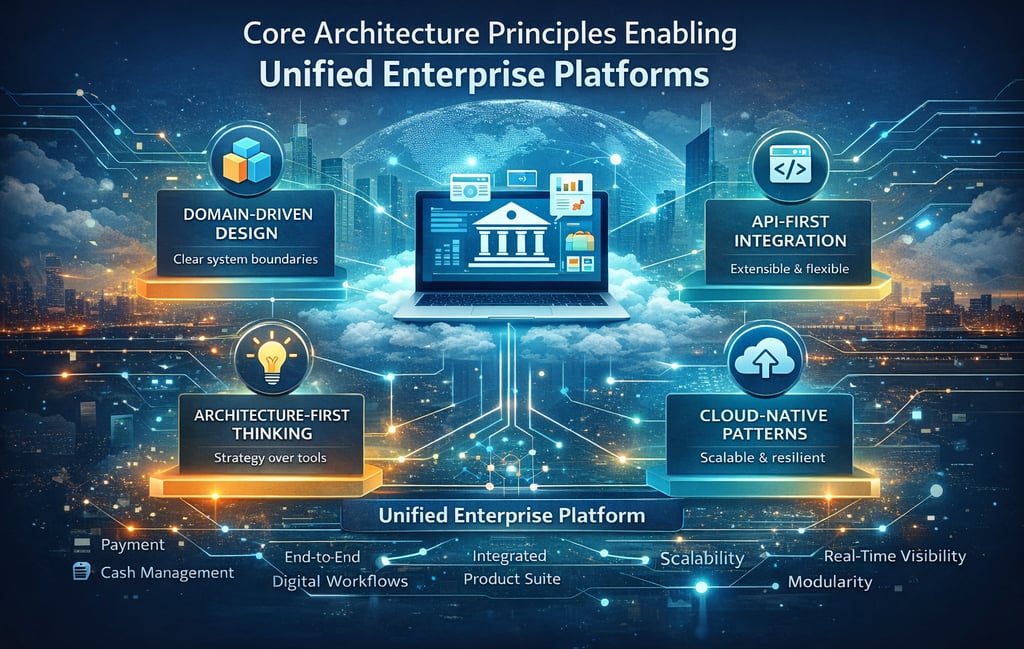
These outcomes are not accidental—they are the result of deliberate architectural decisions:
Architecture-first thinking over tool-driven decisions
Domain-driven design to define clear system boundaries
API-first integration for flexibility and extensibility
Event-driven systems for responsiveness and scale
Cloud-native patterns for resilience and performance
Business Impact
When architecture leads modernization, organizations typically see:
Faster decision-making through unified visibility
Reduced operational cost via automation and ease of use
Increased efficiency through bulk operations and workflows
Improved customer experience across segments
Sustainable scalability without repeated rework
The Deeper Insight
Modernization is not about replacing systems.
It is about re-architecting how systems work together.
How This Connects to the EAM Approach
This is exactly what the EAM (Evolutionary Architecture Modernization) approach enables in practice:
Incremental transformation instead of disruption
Reduced risk compared to big-bang programs
Continuous delivery of business value
Alignment between architecture, business goals, and execution
Apply This Thinking to Your Platform
If your systems are experiencing:
Fragmented user experience across products
Slow innovation cycles
Increasing operational complexity
The problem is likely architectural—not technological.
Start with Clarity, Then Transform with Confidence
A focused architecture-first approach can help you:
Identify structural gaps in your platform
Define the right modernization path
Avoid costly transformation mistakes
👉 Book an Architecture Consultation
No commitment
Practical, architecture-led insights
Tailored to your platform context
Continue Exploring Architecture-Led Transformation
Navigating Architecture-Driven Transformation
Modernizing Enterprise Systems with Precision