See which of the 12 patterns behind failed modernizations your program is showing — 8 minutes, no email. Take the diagnostic →

GitHub Copilot’s billing shift means your allowance now lasts 5 days instead of a month. Here’s why — and how to fix it.
GitHub Copilot’s billing shift means your allowance now lasts 5 days instead of a month. Here’s why — and how to fix it.
ARCHITECTUREAIENGINEERINGTOKENOPTIMIZATION
6/17/20268 min read
GitHub Copilot’s billing shift means your allowance now lasts 5 days instead of a month. Here’s why — and how to fix it.
A pattern has shown up across engineering teams in the past few weeks: the same usage habits that comfortably carried a developer through an entire month of GitHub Copilot work are now burning through the monthly allowance in less than a week. Teams aren't doing more work. They aren't writing more code. Yet the quota that used to last thirty days is gone in five.
This isn't a bug, and it isn't your imagination. It's the direct result of a structural change in how GitHub bills for Copilot usage, layered on top of habits that were always wasteful but, until now, were largely invisible because they didn't cost anything extra. Token optimization — a discipline that used to be a "nice to have" for better AI output — has just become a financial necessity.
What Actually Changed
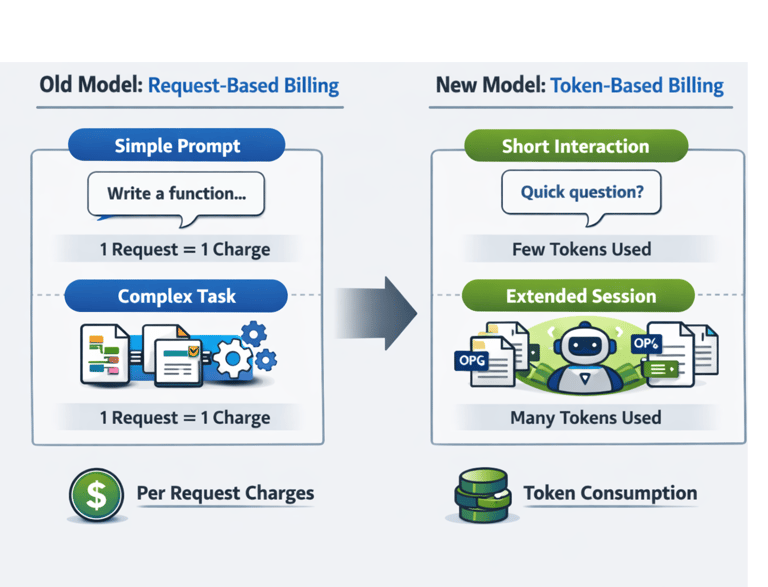
Starting June 1, 2026, GitHub moved Copilot off its old request-based billing model and onto usage-based billing, measured in GitHub AI Credits.
Example: A developer asks Copilot Chat, “Explain this Python error.” Under the old model, that counted as one request — whether the answer was one sentence or a full debugging walkthrough. Under the new token-based model, if the same developer keeps chatting for ten follow-ups, each message resends the entire conversation history, consuming hundreds of tokens. The longer the chat, the higher the cost.
Under the new system, every interaction is billed by the actual tokens it consumes: input tokens (what gets sent to the model, including all the surrounding context), output tokens (what the model generates), and cached tokens (context the model stores or reuses). Each token has a price tied to the model, and the total converts into AI Credits at a fixed rate of 1 credit = $0.01 USD. A short question to a lightweight model might cost a fraction of a credit. A long agentic session running a frontier model across a dozen files costs dramatically more — because it is, quite literally, doing and paying for more work, token by token.
Each Copilot Business seat now comes with 1,900 AI Credits a month (1,900 promotional credits are doubled to roughly 3,000 for the first three months, through September 1, 2026, as a transition cushion); Enterprise seats get 3,900 (temporarily 7,000). Those credits are pooled across the whole organization rather than locked to each individual, so a few heavy users can drain the shared pool quickly even if most of the team is light on usage. Code completions and inline next-edit suggestions remain free and unlimited — the cost lives entirely in chat, agent sessions, code review, Spaces, and CLI usage.
That single design change — billing by token rather than by request — is the reason a habit that used to be "free" (or nearly so) now shows up on the meter in real time.
Why Noise Used to Be Free and Now Isn't
Under request-based billing, inefficiency didn’t cost extra. Under token-based billing, every unnecessary token has a price tag.
Example: Imagine a developer pasting a 500-line React component into Copilot Chat to ask about one small bug. Previously, that was inefficient but harmless. Now, every line of that pasted code is billed as input tokens — even though only 20 lines were relevant. The difference between “paste everything” and “paste what matters” can be several dollars per session.
Consider what changes in practice:
Long-running chat sessions. As a conversation grows, the entire prior history typically rides along with every new message. A session that's accumulated forty exchanges of back-and-forth debugging is now resending most of that history with every single follow-up — at token-metered cost, every time.
Agent mode and multi-file tasks. Agentic workflows are valuable precisely because they explore, read files, and iterate autonomously — but each of those exploration loops consumes input and output tokens against a frontier model. A single "fix this bug" prompt can quietly fan out into many tool calls and file reads behind the scenes, and the credit meter doesn't pause to ask whether each step was necessary.
Frontier and premium models. Not all models cost the same per token. Lightweight, included models are effectively free for paid plans, while top-tier reasoning and coding models carry a meaningfully higher per-token price. Defaulting to the most powerful model for routine tasks — out of habit rather than need — multiplies the bill for no proportional gain in most everyday work.
Code review and repeated context. Automated code review and IDE-based review both consume credits per run, and they tend to recur frequently across a busy repository — another steady drain that's easy to overlook because no single review feels expensive.
Pasted files and redundant explanations. The original failure modes — dumping entire files instead of relevant functions, repeating instructions in three different phrasings, carrying unnecessary background context — behave exactly as before. The difference is that each of those wasted tokens now has a literal price tag attached, deducted from a shrinking shared pool, visible within the same billing cycle rather than absorbed into a flat fee.
None of these habits are new. What's new is that they now compound into a bill that arrives in days, not weeks.
Reframing the Fix: From "Better Answers" to "Controlled Spend"
Everything that improves Copilot’s accuracy also reduces cost.
Example: A team at a fintech startup runs Copilot agents to refactor legacy code. When they scope tasks narrowly (“Refactor the authentication module”), the agent finishes in minutes and uses a few hundred tokens. When they leave it open-ended (“Improve the whole repo”), the agent explores dozens of files, consuming thousands of tokens and draining the shared pool in hours.
Match the model to the task
Routine completions, simple questions, and boilerplate generation rarely need a frontier model. Using the included, lightweight models for everyday work (and reserving premium or frontier models for genuinely complex reasoning or architecture-level tasks) is the single highest-leverage lever available, since per-token model pricing varies substantially across the model lineup. Where available, GitHub's auto model selection feature applies an automatic discount on top of choosing an appropriately sized model for the task, which compounds the savings.
Keep agent sessions scoped
Agent and CLI sessions are powerful precisely because they can run autonomously across many steps — but an unscoped "go improve the whole repo" instruction invites far more exploration (and far more billed tokens) than a tightly defined task. Breaking large asks into smaller, well-bounded sessions, and avoiding mid-task interruptions that restart reasoning loops, keeps consumption proportional to the actual work being done.
Reset stale conversations
A conversation that has drifted across three unrelated problems is dragging all of that history into every new prompt. Starting a fresh session when the topic changes — rather than continuing an old thread out of convenience — directly reduces the input tokens billed on every subsequent message.
Replace pasted context with targeted context
Pasting an entire file when only two functions are relevant, or repeating the same requirement in five different phrasings, inflates input tokens without adding signal. Sharing only the relevant methods, summarizing long background ("Authentication uses JWT with three roles") instead of pasting full documents, and stating constraints once, clearly, does the same job for a fraction of the tokens.
Push repeated context into configuration, not prompts
Repository-level and organization-level custom instructions let a team encode coding standards, architectural constraints, and house style once, so Copilot applies them automatically instead of every developer re-typing the same boilerplate guidance into every prompt. This is one of the more underused levers, and it scales savings across an entire team rather than one developer at a time.
Exclude what shouldn't be in context at all
Content exclusion settings let teams keep certain files, paths, or repositories out of Copilot's context entirely — useful for legacy code, generated files, or sensitive paths that add bulk without adding value to most prompts.
Treat code review consumption as part of the budget, not a footnote
Automated review runs add up quickly across an active repository. Scoping when and where automatic review triggers, rather than letting it fire on every commit and every IDE pass, is worth a deliberate policy decision rather than a default setting.
A Governance Layer for Teams, Not Just Individuals
Because AI Credits are pooled at the organization level, an individual's wasteful habits can drain a budget that other developers are relying on. This makes token discipline a team governance question as much as an individual skill.
Example: A mid-sized SaaS company sets a weekly Copilot usage review. They notice one developer’s long agent sessions consume 40% of the team’s credits. By introducing per-user limits and defaulting to lightweight models for routine tasks, they cut consumption by half without reducing productivity. Governance becomes a cost-control mechanism, not a restriction.
A few practical controls are worth setting up deliberately rather than discovering after the fact:
Set user-level and cost-center budgets so no single heavy user — or one runaway agent loop — can consume a disproportionate share of the shared pool before the rest of the team gets a turn. Monitor usage through GitHub's Copilot usage metrics and activity reports on a weekly cadence rather than only when someone hits a wall, so spend patterns are visible before they become a crisis. Decide, as a policy rather than an accident, which models are the default for which workflows, and document that decision so new team members aren't guessing. And build the "fresh session for a new topic" and "summarize instead of paste" habits into onboarding, the same way code style guides get taught — because these habits now have a direct, visible cost line attached to them.
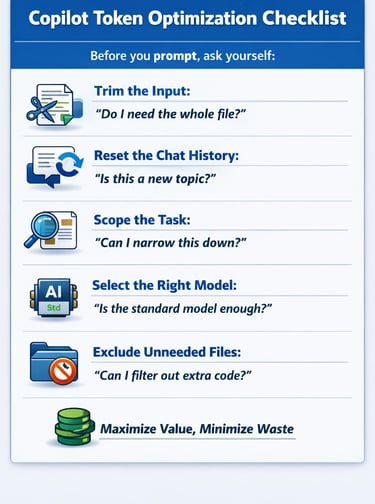
The Checklist, Updated for 2026
Example: Before sending a prompt, a developer asks:
"Do I really need to paste this whole file?” → No, summarize it.
“Is this still the same debugging thread?” → No, start fresh.
“Do I need the frontier model?” → No, use the standard one. Each small decision saves tokens — and collectively, saves the team hundreds of credits per week.
Before sending a request to Copilot, the same five questions from before still apply — but each one now has a dollar value attached:
Is every piece of context in this prompt actually relevant, or is some of it riding along out of habit?
Could this large code block be summarized instead of pasted in full?
Is the task scoped narrowly enough that an agent session won't wander into unnecessary exploration?
Is this the right model for the complexity of the task, or is a frontier model being used out of default rather than need?
Is this still the same topic as the rest of this conversation, or is it time for a fresh session?
Closing Thought
Token optimization was never about saving tokens for their own sake — it was about giving the model exactly what it needs.
Example: Treat Copilot usage like cloud compute spend. You wouldn’t leave a Kubernetes cluster running overnight just because it’s convenient — you’d shut it down when idle. The same discipline applies here: every unnecessary token is like an idle VM burning budget.
Teams that make this adjustment now will get sustainable value from their AI tooling investment. Don’t give AI more tokens — give it the tokens that matter, and know exactly what each one costs.
Note: This article reflects GitHub Copilot's billing model as of June 2026, following the transition from premium-request to usage-based AI Credit billing. Plan allowances, model pricing, and policy options are subject to change — refer to GitHub's official Copilot billing documentation for current figures before setting budgets.
Book an Architecture Consultation with the Stratonavis team for a 30-minute focused session
Talk to an Expert
Discuss your modernization challenges and define the right architecture strategy for your platform.
Architecture-led decision making
Proven modernization outcomes
Enterprise-scale delivery experience
All rights reserved © 2026 Stratonavis Private Limited
Proven across global financial platforms and large-scale enterprise systems.
Trusted by global financial platforms and enterprise systems